The New Neighborhood Economy: Four Service Categories Americans Are Hiring for the First Time
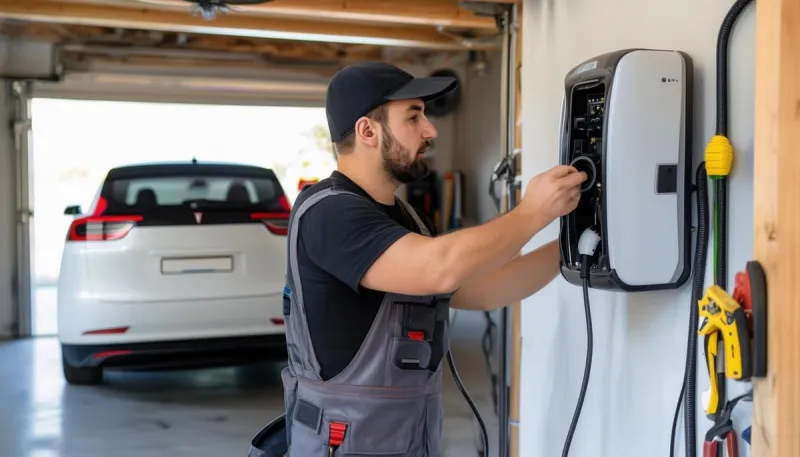
Photo: electrician installing EV home charger in residential garage, via carnuter.com
Drive through a typical American subdivision today and you'll notice things that weren't there five years ago: a charging cable snaking to an electric SUV, a shed-like structure at the back fence line with a desk lamp glowing at 9 p.m., a front entrance with a newly added ramp and grab bars. These aren't isolated quirks. They're the visible surface of a service economy that is expanding into categories most homeowners had never considered hiring for.
For a platform built on connecting consumers with local providers, the shift matters. New service categories mean new providers—many of them talented, some of them improvising—and a vetting landscape without decades of reviews to lean on. Here's what's driving four of the fastest-growing niches, what they typically cost, and how to evaluate a pro when the industry itself is still finding its footing.
Aging-in-Place Modifications
The math is blunt: roughly 10,000 Americans turn 65 every day, and the overwhelming majority say they intend to stay in their current homes. That intention is converting into contracts—zero-threshold showers, widened doorways, stair lifts, improved lighting, and smart-home monitoring.
Typical costs: Grab bars and lighting upgrades run a few hundred dollars; curbless shower conversions commonly land between $5,000 and $12,000; full accessibility retrofits can exceed $25,000.
Vetting note: The strongest credentials here are a CAPS designation (Certified Aging-in-Place Specialist) through the National Association of Home Builders, plus occupational therapy collaboration on larger projects. Ask whether the contractor has worked with clients with specific mobility needs, not just 'seniors' in the abstract.
Home EV Charger Installation
Electric vehicle sales have turned a garage wall outlet into a piece of critical home infrastructure. Level 2 charging requires a dedicated 240-volt circuit, and in older housing stock, often a panel upgrade to match.
Typical costs: Straightforward installations commonly run $500 to $1,500; when a service panel upgrade enters the picture, totals can climb past $3,000. Many utilities offer rebates that meaningfully offset the price—ask the installer, then verify independently.
Vetting note: This work belongs to licensed electricians, full stop. Be wary of handymen who 'also do chargers.' Confirm permitting: most jurisdictions require one, and a legitimate installer will pull it as a matter of course.
Backyard Offices and ADU-Style Builds
Remote and hybrid work transformed the spare bedroom into a workplace, and the spare bedroom into a construction site. Prefab office pods and small accessory structures have become one of the fastest-moving categories in residential contracting.
Typical costs: Prefabricated pods generally range from $15,000 to $40,000 installed; custom builds and detached accessory dwellings run far higher, sometimes past $100,000 in high-cost metros.
Vetting note: Zoning is the hidden trap. Setbacks, lot coverage limits, and permitting requirements vary wildly—even between neighboring towns. A credible builder will walk you through local rules before quoting. One who promises 'no permit needed' is handing you a future problem, potentially one that surfaces during a home sale.
Post-Storm Mitigation Work
As severe weather events have intensified across the Gulf Coast, the Plains, and increasingly the Northeast, mitigation—the practice of hardening a home against the next event—has grown from an insurance afterthought into a standalone trade. Impact-rated windows, reinforced roofing, drainage corrections, and elevated mechanical systems now anchor a genuine industry.
Typical costs: Varies enormously by scope, from under $1,000 for drainage work to tens of thousands for window and roof hardening. Insurance premium discounts frequently apply; request documentation you can submit to your carrier.
Vetting note: This category attracts opportunists after every major storm. Verify state licensure where applicable, demand certificates of insurance, and be skeptical of any contractor who appears unsolicited after a weather event or demands full payment upfront.
Vetting in a Young Industry: The Universal Playbook
When a category lacks long track records, shift the evidence you rely on:
- Prioritize transferable credentials. A license in the underlying trade—electrical, general contracting, plumbing—matters more than a niche certificate alone.
- Ask for the permit history. Newer providers doing legitimate work will have it.
- Request references from the last twelve months, since the provider's current operation is what you're hiring, not their decade-old reputation.
- Confirm insurance before, not after, signing. Newer firms sometimes let coverage lapse during growth phases.
The neighborhoods are changing faster than the directories that serve them. Homeowners who learn to evaluate emerging categories now will find themselves ahead of the curve—and, in several of these cases, ahead of the next insurance premium increase or the next storm season.